Ask ten people what a chauffeur drives and most will picture a Rolls-Royce or a Bentley. The reality on British roads is quieter and a lot more practical. The cars that do the real work, day in and day out, come almost entirely from one badge. Most guides on this topic list aspirational cars nobody puts you in for a school run or an airport pickup, so here is the version that answers the question people actually mean: what will my chauffeur arrive in, and which car suits my trip?
TL;DR
Most UK chauffeurs drive the Mercedes E-Class, S-Class and V-Class, with the Range Rover and a luxury minibus filling out larger fleets. The S-Class is the most requested car for executive and VIP work. The E-Class covers everyday business trips and airport runs, and the V-Class handles groups, families and heavy luggage. What actually turns up depends on the class you book, not luck on the day.
The short answer: What cars do chauffeurs drive?
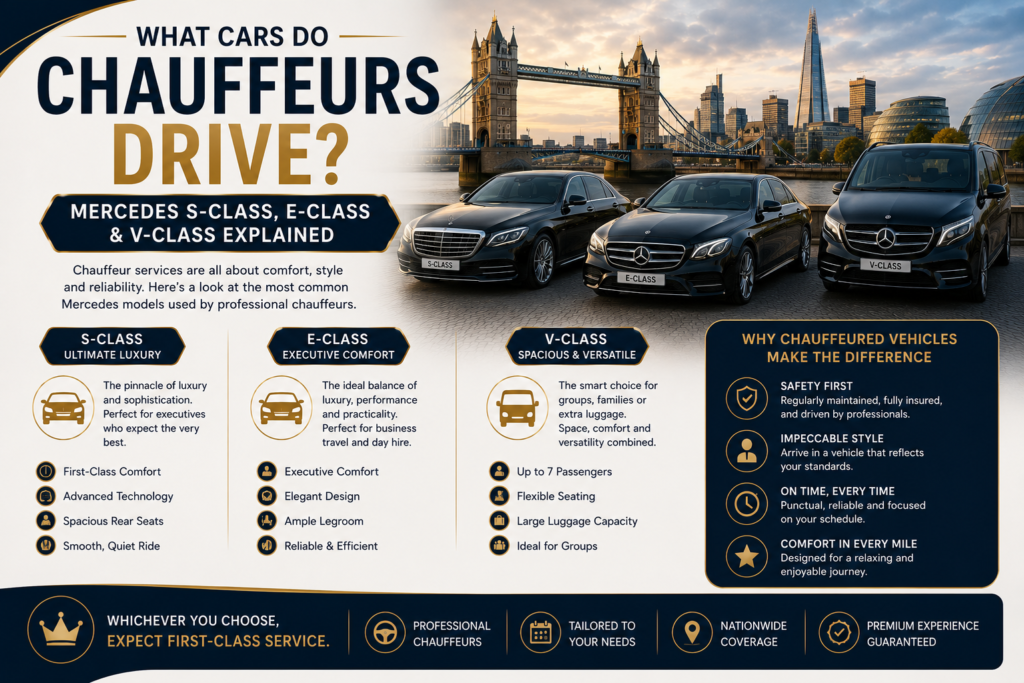
Chauffeurs in the UK mostly drive executive saloons and MPVs from Mercedes, led by the E-Class, S-Class and V-Class. Companies build fleets around these because they seat passengers comfortably, swallow airport luggage, and stay reliable across long working days. Bigger names like the Range Rover and a stretched minibus cover the edges, but the Mercedes trio does the bulk of the work.
The reason is boring and correct: these cars balance comfort, running cost and image better than anything flashier. A Bentley looks the part outside a hotel and makes no sense on a 6am airport pickup. You can see the split clearly across our chauffeur fleet, where every vehicle is a working car rather than a showpiece.
Mercedes E-Class: the executive saloon most trips start with
The E-Class is the default. It seats up to 3 passengers, takes a couple of large cases without a squeeze, and rides smoothly enough that you can work or rest on the way. For solo business travellers and standard airport transfers, this is the car doing the quiet majority of jobs.
Price is part of why. A Chauffeur Force E-Class runs Heathrow to Central London for a fixed £135, or £50 per hour for as-directed work. That keeps a professional chauffeur within reach for a morning of meetings, not just special occasions. If you want the details on the car itself, the Mercedes E-Class chauffeur page covers specs and passenger space.
Most people who book an executive transfer and do not specify a class end up in an E-Class, and rightly so. It does everything a single traveller needs and nothing they are paying extra to ignore.
Mercedes S-Class: why it is the standard for executive and VIP travel
If there is one car that defines chauffeur work, it is the S-Class. It is the answer to “Is the Mercedes S-Class the best chauffeur car?” and for most executive briefs, the honest answer is yes. The rear cabin is quieter, the seats are better, and the badge carries weight when a client is being collected. That combination is why it sits at the top of nearly every serious fleet.
The S-Class seats up to 3 like the E-Class, so you are not paying for more room. You are paying for a calmer, more refined cabin and the presence that comes with it. Chauffeur Force prices the S-Class at £220 Heathrow to Central London and £65 per hour, which is the step most corporate bookers take when the passenger is senior or the occasion matters. Spec and interior detail sit on the Mercedes S-Class chauffeur page.
Book it for board-level pickups, weddings, and any trip where arriving well is the point. For a regular commute or a supermarket run, it is more car than the moment needs.
Mercedes V-Class: the choice for groups and luggage
Once you are travelling with three or more people, or landing with a mountain of cases, the saloons run out of room and the V-Class takes over. It seats up to 7 in proper comfort, with space for luggage that would defeat any boot. Families, small delegations and airport groups live in this car.
At £195 Heathrow to Central London, the V-Class often works out cheaper per head than two saloons, which surprises people. Full spec is on the Mercedes V-Class chauffeur page.
Mercedes V-Class vs S-Class: Which Should You Book?
This is the most common fleet decision, so here is the quick version.
| Mercedes S-Class | Mercedes V-Class | |
|---|---|---|
| Passengers | Up to 3 | Up to 7 |
| Best for | Solo or paired VIP, executive image | Groups, families, heavy luggage |
| Heathrow to Central London | £220 | £195 |
| Per hour | £65 | £65 |
| Cabin feel | Refined, low-profile luxury | Spacious, sociable, van-based comfort |
Pick the S-Class when the passenger matters more than the headcount. Pick the V-Class when the headcount or the luggage is the deciding factor.
Range Rover and the luxury minibus: the rest of the fleet
Two more cars round things out. The Range Rover Sport carries up to 4 with a higher seating position some clients prefer, and lands at £220 Heathrow to Central London or £90 per hour. Beyond that, a Mercedes luxury minibus handles larger groups, roadshows and events where a V-Class is not enough.
Pricing across these tiers is worth understanding before you book, because the gap between an E-Class and a Range Rover is real money over a full day. If you want the wider picture on rates, our guide on how much does a chauffeur cost breaks down hourly, half-day and full-day pricing by vehicle.
Electric chauffeur cars in the UK: where things stand
Electric chauffeur cars are a genuine trend, not a gimmick. Models like the Mercedes EQS and EQV, the BMW i7 and the Tesla Model S turn up on more fleets every year, driven by low-emission zones and clients who want a cleaner option for city work. Expect the executive EV share to keep climbing through 2026.
That said, most established fleets, including Chauffeur Force, still run the Mercedes E-Class, S-Class and V-Class as their core cars, with the Range Rover for SUV work. If an electric vehicle matters for your booking, ask when you enquire so availability can be confirmed rather than assumed. The petrol and diesel executive cars remain the backbone for now, mainly because range and turnaround suit long airport days.
What car will actually arrive for your booking?
Here is the part that most guides skip. You are not gambling on what shows up. You book a vehicle class, and that class is what arrives. Choose an E-Class and an E-Class collects you; choose a V-Class for a group and a V-Class is what pulls up.
If a specific car matters, say so at the booking stage. Chauffeur Force runs its fleet from a Heathrow base, so matching the right vehicle to airport transfers, day hire or a group trip is straightforward when the request is clear. Every car comes with a licensed, DBS-checked chauffeur, 60 minutes of free airport waiting, flight tracking and onboard WiFi as standard, whichever class you pick.
The short rule: the car you choose is the car you get, so choose for the trip in front of you rather than the badge.
Key Takeaways
- The three cars that dominate UK chauffeur fleets are the Mercedes E-Class, S-Class and V-Class.
- The Mercedes S-Class is the most popular chauffeur car for business and VIP travel.
- The E-Class is the everyday executive saloon; the V-Class carries up to 7 with luggage.
- Chauffeur Force runs all three, plus a Range Rover and a luxury minibus, from its Heathrow base.
- You book by vehicle class, so the car you choose is the car that shows up.
Frequently asked questions
What cars do chauffeurs drive in the UK?
Mostly the Mercedes E-Class, S-Class and V-Class, with the Range Rover and luxury minibuses on larger fleets. These cars balance passenger comfort, luggage space and reliability across long working days better than showier alternatives.
Is the Mercedes S-Class the best chauffeur car?
For executive and VIP travel, yes. It offers the quietest, most refined rear cabin of the common chauffeur cars and the strongest presence for client pickups, which is why it tops nearly every serious fleet.
What car will my chauffeur arrive in?
The class you booked. Chauffeur work is arranged by vehicle type, so an E-Class booking brings an E-Class and a V-Class booking brings a V-Class. Request a specific car at the booking stage if it matters.
Mercedes V-Class vs S-Class, which is better?
The S-Class suits one or two passengers who want executive comfort and image. The V-Class suits three or more, or anyone with heavy luggage, seating up to 7. Passenger count and cases decide it.
Do chauffeur companies use electric cars?
Some do, and the number is growing with models like the Mercedes EQS and EQV. Most fleets still run petrol and diesel executive Mercedes as their core cars, so check availability when you book if you want an electric vehicle.
How many passengers fit in each chauffeur car?
The E-Class and S-Class each seat up to 3, the Range Rover up to 4, and the V-Class up to 7. For larger groups, a luxury minibus is the next step up.