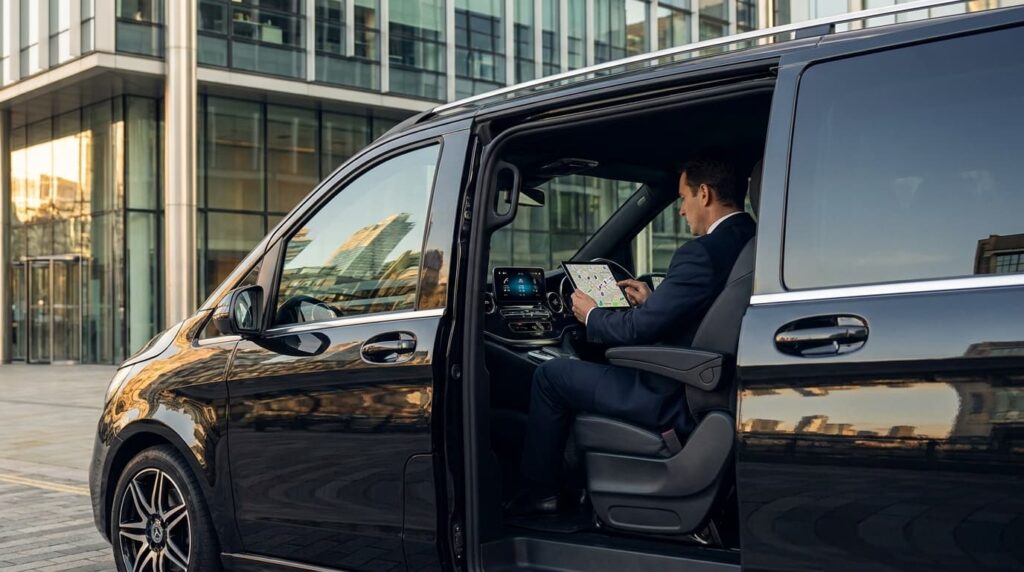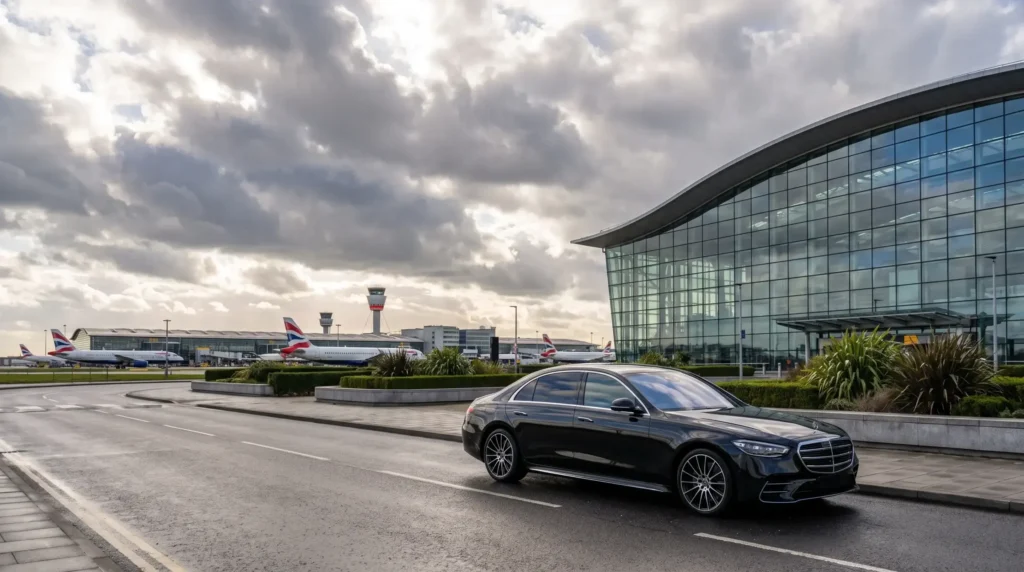

A chauffeur service is a pre-booked private driver who collects you in a luxury car and handles the whole trip door to door. You agree the price before you travel, the driver is uniformed and professionally trained, and things like flight tracking, waiting time and help with your bags come as standard rather than as paid extras.
Most explainers stop at that definition and a quick list of duties. The part people actually want, what happens the first time you book, minute by minute, tends to get skipped. That’s the gap this guide fills.
TL;DR
A chauffeur service is a pre-booked professional driver in a high-end vehicle, at a fixed & agreed price — no meter. The driver looks after your route, timing and luggage. Booking for the first time? Expect a confirmation with your driver’s name and car details, a meet-and-greet at pickup, and a set fare that doesn’t change if traffic is bad.
What a chauffeur service includes (and what it doesn’t)
The word “chauffeur” gets used loosely, so it helps to be clear about what you’re paying for. At its core, this is a private-hire arrangement: one dedicated driver, one vehicle, booked for you and only you, for a set fare.
What’s usually built into that fare surprises first-timers. With Chauffeur Force, for example, airport pickups come with 60 minutes of free waiting time, live flight tracking, onboard Wi-Fi, and parking and tolls already included in the quoted price. There’s no meter ticking while you find your bags. If you want to see how that works across airport runs and hourly hire, our chauffeur service sets out the fixed rates in one place.
What it doesn’t include is the unpredictability of a metered fare. You know the number before you get in, and it stays that number.
What does a chauffeur do?
A chauffeur does a lot more than steer. They plan the route around traffic and roadworks, time the pickup to your schedule (or your flight), load and unload your luggage, and keep the car clean, fuelled and comfortable. Discretion is part of the job too for business travellers and corporate accounts, a chauffeur who says little and notices everything is the point.
There’s also the professional standard behind the person. A proper chauffeur is DBS-checked, individually licensed, and trained to a service standard rather than just holding a driving licence. You can read more about our chauffeurs and the checks every driver goes through before they’re allowed behind the wheel of a client’s car.
Good chauffeurs anticipate. They’ll have the door open before you reach it, know which terminal exit is quickest, and adjust the pickup without being asked when a flight lands early.
Chauffeur vs private hire vs minicab: what’s the difference?
This trips people up because the licensing overlaps. In the UK, chauffeur services operate under a private-hire operator licence, the same broad category as a standard minicab firm. What separates a chauffeur from a regular private-hire driver is the vehicle class, the service level, and the fact that everything is pre-arranged rather than dispatched on demand.
A private chauffeur, then, is a private-hire driver at the top of that scale: executive car, uniform, fixed price, booked ahead. If you want the full breakdown of where each option sits on cost, comfort and booking method, this guide on chauffeur vs taxi lays it out side by side. The short version: a black cab is metered and hailed, a minicab is booked and cheaper, and a chauffeur is booked, fixed-price and built around comfort.
Your first booking, step by step
Here’s what actually happens, from the moment you book to the moment you’re dropped off.
1. You book and confirm. You give the pickup, destination, date, time and passenger count, then get a fixed quote back. Once confirmed, you receive your driver’s details in advance.
2. The car and driver are assigned. You’re matched to a vehicle that fits the trip. A solo airport run might get a Mercedes E-Class (from £135 Heathrow to central London); a family or small group gets a V-Class people-carrier. If you’re curious about the fleet, this guide on what cars do chauffeurs drive explains the differences.
3. Pickup and meet-and-greet. For a home or office pickup, the driver arrives early and waits at the kerb. For an airport, they park up, walk into arrivals, and hold a name board with your name on it; that’s the meet-and-greet. Flight tracking means they already know if you’ve landed late.
4. The drive. You sit back. The driver handles the route, the timing and the small talk (or the silence, if you’d rather work). Water and Wi-Fi are usually there if you need them.
5. Drop-off. They pull up, get your bags out, and that’s it. Nothing to settle at the end if you’ve paid ahead; the fare was fixed before you started.
The whole thing is designed so a first-timer never has to guess what comes next.
Chauffeur etiquette: front or back, tipping and luggage
A few unspoken rules make the first trip smoother.
Do you sit in the front or the back? The back is standard. It’s the more comfortable, more private option, and most chauffeurs expect it. Sitting in the front isn’t rude, though. Plenty of solo passengers prefer it for the legroom or the chat, and no driver will mind if you ask.
On tipping: it’s genuinely optional in the UK, and never expected on a chauffeur trip. If a driver’s gone out of their way, 10% or a round £10–£20 is a kind gesture, but plenty of clients don’t tip at all and that’s completely normal. Our full note on whether you should do you tip a chauffeur covers the awkward “when is it already included” question.
Luggage is the driver’s job, not yours. Let them load and unload since it’s part of the service, and wrestling your own case into the boot while they stand there just makes everyone uncomfortable.
Key Takeaways
- A chauffeur is booked in advance for a specific pickup, not flagged down on the street.
- You pay a fixed price agreed upon upfront. The fare doesn’t move with traffic or the clock.
- The car is executive-class (typically a Mercedes E-Class, S-Class or V-Class) and spotless.
- Airport pickups include a name-board meet-and-greet, flight tracking and free waiting time.
- Back seat is the norm, but the front is fine, and tipping is optional, not expected.
Frequently asked questions
Do you sit in the front or back with a chauffeur?
The back seat is standard and what most drivers expect, since it’s more private and comfortable. Sitting in the front is perfectly acceptable if you prefer the space or the conversation, just say so.
What’s the difference between a chauffeur and a private-hire driver?
Both work under a private-hire licence. A chauffeur sits at the top end: executive vehicle, uniform, fixed price, and a booking arranged in advance rather than a car dispatched on demand.
Do I need to tip a chauffeur in the UK?
No. Tipping is optional and never expected. If you want to, 10% or a flat £10–£20 is generous, but many clients don’t tip and it’s not seen as impolite.
What happens if my flight is delayed?
Nothing on your end. A chauffeur service with flight tracking adjusts your pickup to the real arrival time, and free waiting time (60 minutes at Chauffeur Force) covers the wait through passport control and baggage.
Is a chauffeur service worth it for just one person?
Often, yes. Especially for airport runs, early flights or business travel where reliability and a fixed price matter more than the lowest fare. A solo executive saloon starts from £135 Heathrow to central London.
How far ahead should I book?
For airports and events, 24 to 48 hours is comfortable and locks in the car you want. Same-day bookings are often possible, but availability tightens at peak times and on early mornings.